


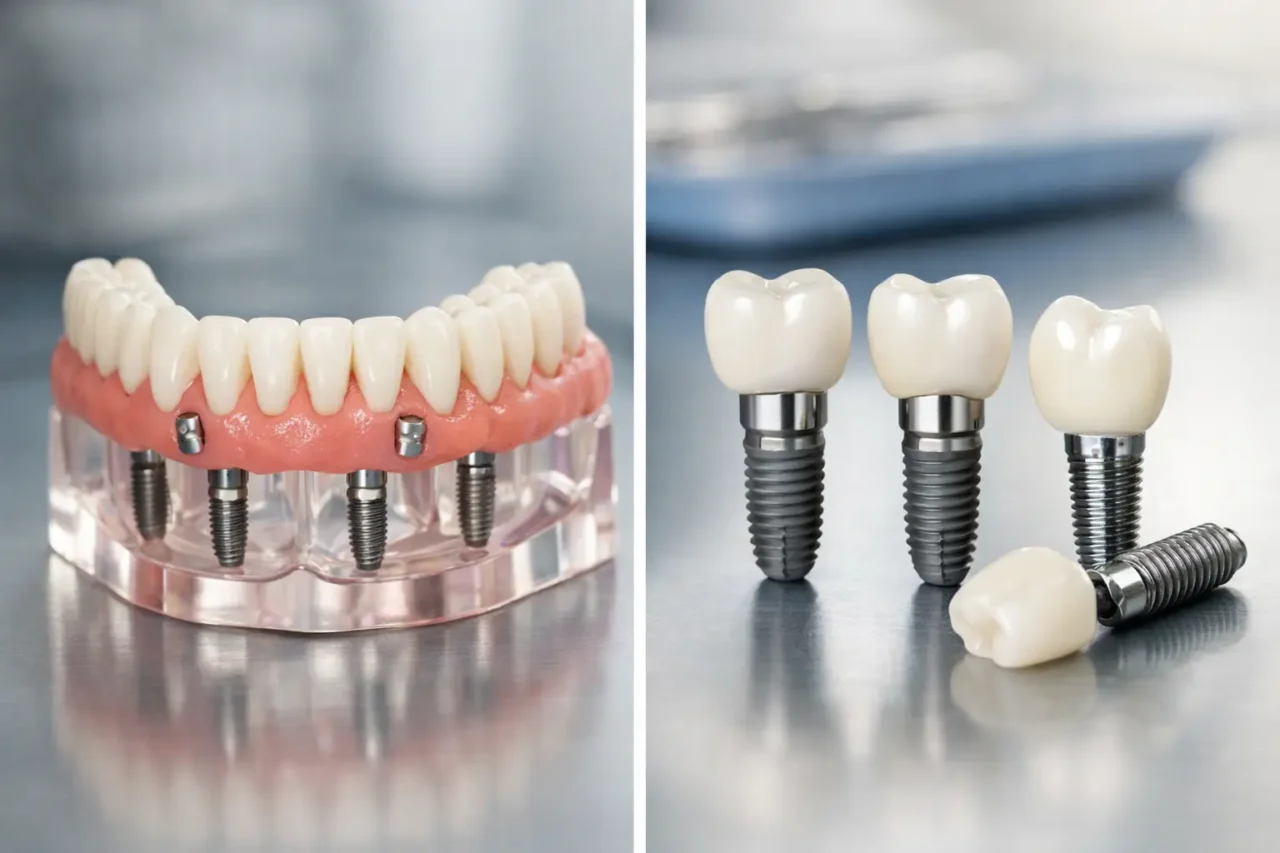
A full smile restoration is not simply about replacing teeth. It is about choosing a solution that feels secure when you eat, looks natural in photos, and fits the time and budget you can commit to. When comparing all on four vs implants, the key distinction is easy to miss: All-on-4 is itself an implant treatment, but it is designed to support a complete arch of teeth rather than replace one missing tooth at a time.
For international patients, that difference affects nearly every part of treatment planning, from scans and healing time to the number of visits you may need in Cartagena. The right choice depends on how many teeth are missing, the condition of the teeth that remain, your jawbone, and your goals for function and appearance.
What is the difference between All-on-4 and regular implants?
A traditional dental implant replaces the root of one missing tooth. A titanium implant is placed in the jawbone, allowed to integrate with the bone, and restored with a custom crown. If several teeth are missing in separate areas, individual implants may be used to support individual crowns or an implant bridge.
All-on-4 uses four strategically positioned implants to support a fixed full-arch prosthesis. In practical terms, this means a patient can replace all upper teeth, all lower teeth, or both arches with a fixed set of teeth supported by implants. The rear implants are often placed at an angle, allowing the dentist to make the most of available bone in many cases.
Neither option is automatically better. Individual implants preserve a more tooth-by-tooth approach when healthy natural teeth remain. All-on-4 is often a more efficient full-mouth solution when most or all teeth in an arch are failing, missing, severely worn, or no longer predictable to restore.
When individual implants may be the better choice
If you are missing one tooth, individual implant treatment is typically the most conservative and natural-looking option. The implant and crown stand independently, without relying on neighboring teeth for support. This can help preserve the teeth beside the gap while restoring normal chewing function.
Individual implants can also be an excellent choice when you have several missing teeth but still have healthy teeth worth keeping. Rather than remove healthy teeth to create a full arch restoration, your dentist may recommend placing implants only where they are needed. In some cases, two or more implants can support a fixed bridge, replacing several adjacent missing teeth without needing an implant for every tooth.
This approach does require enough healthy jawbone at each planned implant site. If bone has been lost after years without a tooth, grafting or other preparatory treatment may be recommended. That can lengthen the overall timeline, but it may still be the best long-term plan when the rest of your smile is stable.
When All-on-4 can make more sense
All-on-4 is intended for people facing widespread tooth loss or a failing dentition. Patients often consider it after years of loose teeth, repeated crowns and root canals, advanced gum disease, extensive decay, or removable dentures that move while speaking or eating.
A major advantage is that a complete arch can be supported with fewer implants than a conventional full-mouth approach. In many suitable cases, the available bone can be used without extensive grafting, especially because of the angled placement of the posterior implants. This can reduce surgical complexity and make treatment possible for patients who were told they did not have enough bone for traditional implants.
Many patients receive a fixed temporary bridge shortly after surgery, provided their clinical situation allows for immediate loading. This is not the same as receiving the final teeth on the day of surgery. The temporary restoration protects the healing implants and gives you a functional, presentable smile while the bone integrates. Your final custom bridge is created after the healing phase, when your bite, gums, and implant stability can be evaluated properly.
All on Four vs implants: comparing the real trade-offs
The decision should never be based on implant count alone. It should be based on what gives you the healthiest, most predictable foundation for the future.
With individual implants, treatment can be highly conservative. Healthy teeth remain untouched, and each restoration can be planned around your natural smile. However, replacing many teeth one by one may involve more implant sites, more complex bone preparation, and a longer treatment sequence.
With All-on-4, the treatment can restore an entire arch with a fixed prosthesis and fewer implant fixtures. It is often an efficient choice for full-mouth rehabilitation, but it usually requires removing any remaining teeth in that arch that cannot be predictably maintained. The final bridge is also a connected restoration, so maintenance and repairs are approached differently than they are with individual crowns.
Cost is another important consideration. A single implant may appear less expensive at first, but multiple implants, crowns, extractions, grafting, and temporary restorations can add up quickly. All-on-4 has a larger upfront scope, yet it may be more cost-effective than replacing an entire failing arch tooth by tooth. A personalized treatment plan is the only meaningful way to compare costs fairly.
Bone health, gum disease, and candidacy
Good candidates for either treatment need a thorough clinical evaluation. Digital imaging, oral examination, bite analysis, and a review of your medical history help determine whether implants are appropriate and where they can be placed safely.
Active gum disease must be addressed before or as part of implant treatment. Implants do not get cavities, but the surrounding tissues can develop inflammation and bone loss if plaque is not controlled. Smoking, uncontrolled diabetes, teeth grinding, and certain medical conditions can also affect healing and long-term outcomes. These factors do not always rule out implants, but they need honest discussion and careful planning.
For All-on-4 patients, the quality and shape of the jawbone are especially important. Some people are candidates for four implants, while others benefit from additional implants or a different full-arch design. A reputable provider will not force every patient into the same protocol. The goal is a stable restoration that matches your anatomy, bite forces, and cosmetic expectations.
Planning treatment when you are traveling to Cartagena
Dental travel works best when the clinical plan is as organized as the travel plan. Before you book, an online consultation can help determine whether you may be a candidate. Recent X-rays, photos, and details about prior dental work provide a useful starting point, although an in-person exam and 3D imaging are necessary before final treatment decisions are made.
For individual implants, treatment is often completed in stages. Implant placement may be followed by a healing period before the final crown or bridge is delivered. Depending on your case, this can mean arranging more than one visit.
All-on-4 treatment may allow for a more concentrated first visit because extractions, implant placement, and a temporary fixed bridge can sometimes be coordinated within the same treatment window. You should still plan for a final restoration after healing. Rushing the final bridge before the tissues and implants are ready can compromise fit, comfort, and long-term results.
At Smile Makeover Cartagena, clear English communication and customized planning help international patients understand what can be completed during each visit, what needs time to heal, and what is included in their proposed treatment. That clarity matters as much as the destination when you are investing in a new smile.
What should you ask before choosing?
Ask your dentist whether the teeth you have left are truly maintainable, not merely treatable in the short term. Ask how your bite, bone level, gum health, and cosmetic goals affect the recommendation. You should also understand the planned temporary restoration, the expected healing period, the material proposed for the final teeth, and the maintenance required after treatment.
A good treatment plan should explain alternatives, including the option to preserve healthy teeth when possible. It should also be transparent about limitations. No implant solution is maintenance-free, and no responsible dentist can promise the same outcome for every patient.
The most valuable next step is a personalized evaluation that looks beyond the number of missing teeth. Whether your best option is one carefully placed implant or a full-arch All-on-4 restoration, the right plan should leave you with a smile that feels comfortable, natural, and built for everyday life.
