


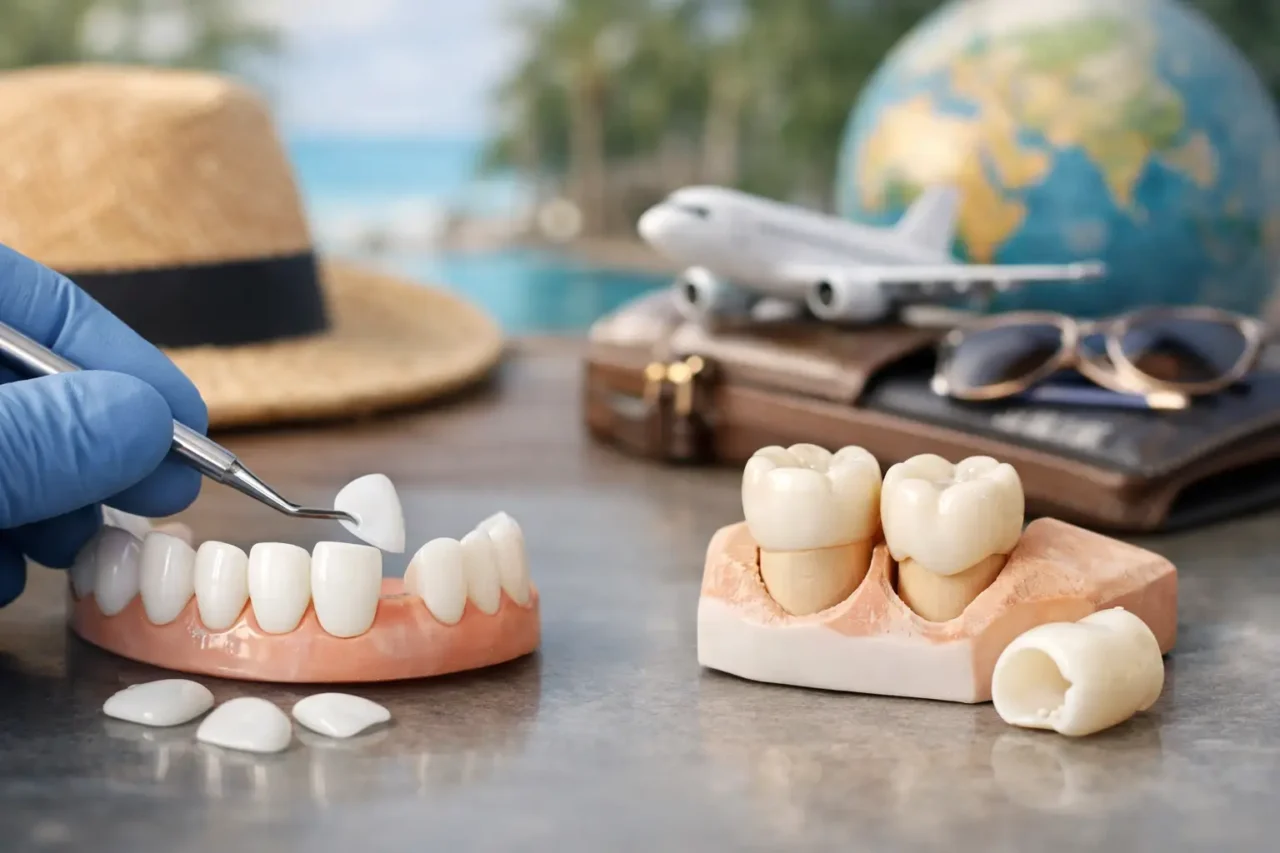
If you are weighing veneers vs crowns abroad, the real question is not which treatment is better. It is which one solves your specific problem without over-treating the tooth or disappointing you cosmetically. For international patients, that decision also has to factor in travel time, number of visits, budget, and how much natural tooth structure can be preserved.
Patients often start with the cosmetic goal – a brighter, more even smile – and then discover that the clinical answer depends on what is happening underneath. A chipped front tooth, a heavily filled tooth, old dental work, grinding habits, root canal history, and bite alignment all change the recommendation. That is why the right plan starts with diagnosis, not just photos of celebrity smiles.
Veneers vs crowns abroad: the core difference
Veneers cover the front surface of a tooth. Crowns cover the entire tooth. That sounds simple, but it changes almost everything about treatment.
Porcelain veneers are usually chosen when the tooth is healthy enough structurally and the main goal is esthetics. They can improve color, shape, length, small gaps, and minor unevenness. When done well, they create a refined, natural-looking result with less tooth reduction than a full crown.
Crowns are usually chosen when a tooth needs more support. If a tooth is cracked, heavily restored, weakened after a root canal, badly worn down, or has major structural loss, a crown may be the safer option. In those cases, the goal is not only appearance but long-term protection and function.
This is where many patients get tripped up. They ask for veneers because they want a cosmetic upgrade, but one or two teeth may actually need crowns. Or they assume crowns are stronger and therefore always better, when in fact a healthy front tooth may not need full coverage at all.
When veneers make more sense
Veneers are often the better choice when your teeth are basically healthy but do not look the way you want them to. Think stubborn discoloration that whitening cannot fix, small chips, mild spacing, short or worn edges, or teeth that look slightly irregular in size and contour.
For smile makeover patients, veneers can be a very efficient way to create symmetry and brightness while keeping treatment focused on the visible front surfaces. They are especially appealing to professionals and image-conscious patients who want a dramatic aesthetic improvement without unnecessary intervention.
That said, veneers are not a shortcut for every cosmetic concern. If the tooth has a large filling, active decay, major fracture lines, or significant bite stress, the result may not last as well. Veneers also require realistic expectations. They can improve shape and color beautifully, but they are not meant to rebuild severely damaged teeth.
When crowns are the better investment
Crowns tend to make more sense when strength matters as much as appearance. If a tooth has already lost a lot of natural structure, a veneer may simply not offer enough coverage or protection.
This is common in patients who have old dentistry, broken teeth, root canal-treated teeth, or years of wear from grinding. A crown can restore shape, seal and support the tooth, and improve how it functions in the bite. On front teeth, modern ceramic crowns can still look highly natural, but the planning has to balance beauty with durability.
For international patients, crowns can also be part of a larger restorative plan. If you are already addressing missing teeth, bridges, implants, or bite rehabilitation, a crown may fit the broader treatment strategy more predictably than veneers alone.
The cosmetic difference patients notice most
If your top priority is the most refined cosmetic finish on visible front teeth, veneers often have an edge. Because they are designed specifically for the front-facing surface, they can deliver exceptional translucency, contour, and light reflection. That is why they are closely associated with smile design.
Crowns can also be beautiful, but they are doing more work. They have to cover the full tooth and manage function from every angle. When a tooth truly needs a crown, that trade-off is worth it. But if a tooth is healthy and the concern is mostly esthetic, many patients prefer the more conservative approach of veneers.
The right answer often ends up being a combination. Some patients need veneers on the most visible teeth and crowns on teeth that are structurally compromised. A good treatment plan does not force every tooth into the same category.
Veneers vs crowns abroad: what to think about before you travel
Travel adds a practical layer to this decision. Veneers and crowns can both work very well for dental tourism, but they require careful timing. You want enough time for consultation, tooth preparation if needed, temporaries, final placement, bite adjustment, and a quality check before you fly home.
If you are traveling from the United States or Canada, efficiency matters. So does communication. You should know in advance whether your case is likely veneer-based, crown-based, or mixed, and how many teeth are involved. A virtual consultation using photos, X-rays, and your dental history can help set expectations, but the final decision should always be confirmed in person after examination.
Patients comparing treatment abroad often focus first on price. That matters, and it is one reason many people look to Colombia in the first place. But lower pricing should not tempt you into choosing veneers when a crown is clinically safer, or crowns when veneers would preserve more healthy tooth structure. The long-term cost of replacing poorly selected treatment is rarely a bargain.
Cost, value, and the temptation to choose by price alone
Veneers and crowns abroad are both typically more accessible than in the US, but the better value depends on your needs. Veneers may look like the cosmetic choice and crowns the restorative one, yet neither should be picked from a menu.
If your tooth can be conservatively improved with a veneer, placing a crown just because it seems like a more comprehensive fix may be unnecessary. If your tooth is already weak, choosing a veneer because it costs less or sounds less invasive can create problems later.
Value comes from getting the correct treatment the first time, with materials, design, and preparation matched to your tooth condition and bite. For travelers, value also means fewer surprises, a clear treatment sequence, and enough coordination to avoid extra flights or rushed decisions.
How many visits do veneers or crowns require abroad?
In many cases, both veneers and crowns can be completed within a well-planned treatment window, but the exact schedule depends on the complexity of the case and the type of restoration being made. A single tooth is very different from a full cosmetic arch.
Patients often assume veneers are always faster. Sometimes they are, especially in straightforward cosmetic cases. But a crown on one damaged tooth may also be simple, while a multi-unit veneer case may require more detailed planning, mock-ups, and esthetic refinement.
This is why personalized scheduling matters. At Smile Makeover Cartagena, international patients typically benefit most from a structured process that starts before arrival, so clinical planning and travel logistics support each other rather than compete.
Questions worth asking before you commit
Before you choose veneers or crowns abroad, ask what problem each treatment is solving. Ask how much healthy tooth structure will be preserved. Ask what happens if you grind your teeth. Ask how many visits are needed and whether temporaries will be used. Ask what maintenance looks like when you return home.
Most of all, ask whether your goals are cosmetic, functional, or both. A beautiful smile that chips because the bite was not addressed is frustrating. A strong restoration that looks bulky or opaque on front teeth is just as disappointing. Good dentistry respects both function and appearance.
The best choice is the one that fits your teeth, not the trend
Veneers photograph well and crowns sound reassuringly strong, but your mouth is not a social media template. The best treatment abroad is the one that matches your dental reality, your aesthetic goals, and your travel timeline without compromise.
If you are choosing carefully, that is a good sign. The right provider will not push you toward one option because it is more popular. They will show you where veneers shine, where crowns are the better protection, and where a mixed plan creates the most natural, lasting result. When that happens, the trip is not just worth the savings. It is worth the confidence you bring home with you.
