


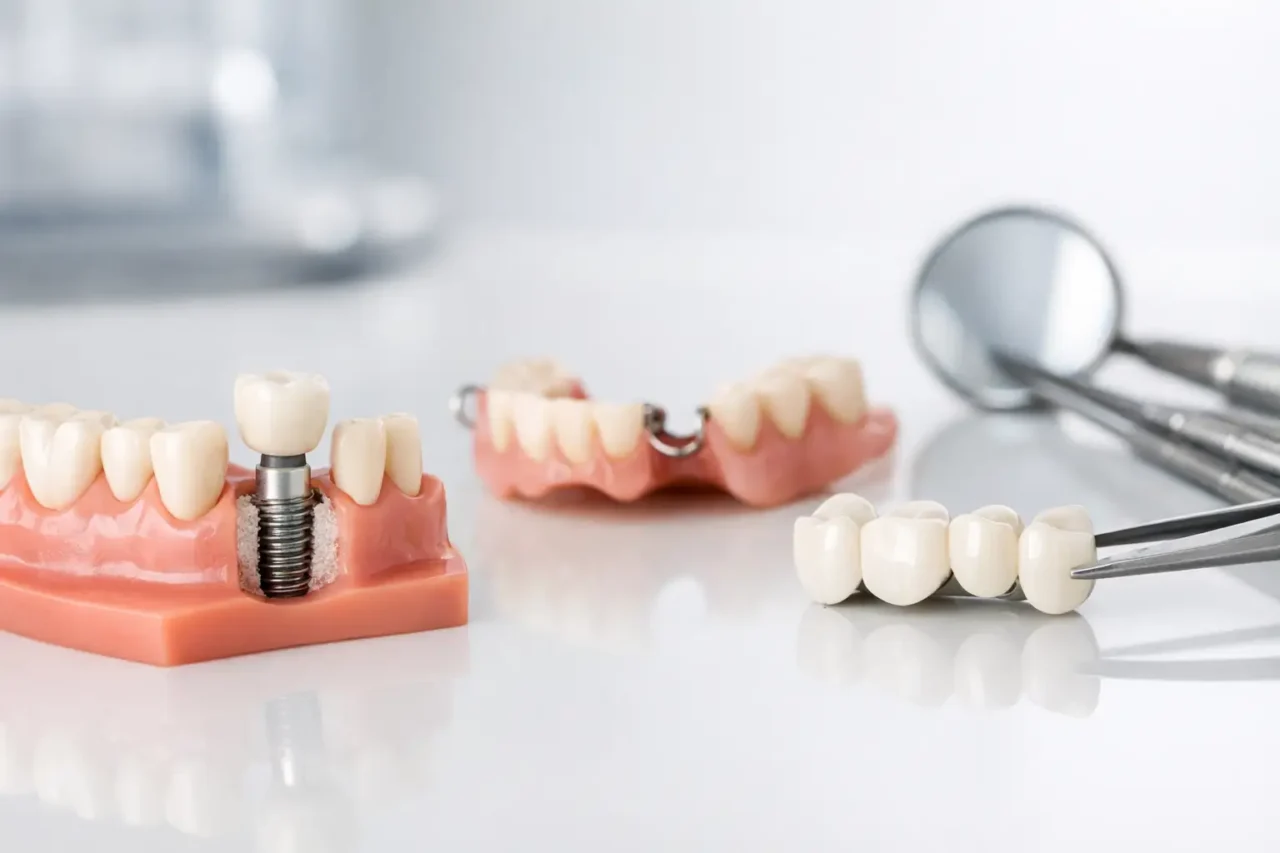
Losing a tooth changes more than your smile. It can affect how you chew, how clearly you speak, how your bite fits together, and how confident you feel in everyday conversations. That is why understanding your missing teeth treatment options matters early – before nearby teeth shift, bone loss progresses, or a simple fix becomes a more complex one.
For some patients, the right answer is a single dental implant. For others, a bridge or a well-made removable prosthesis makes more sense. The best treatment depends on where the tooth is missing, how many teeth are involved, the health of the surrounding bone and gums, your timeline, and your budget. A good treatment plan is not about picking the most expensive option. It is about choosing the option that gives you the best mix of function, appearance, durability, and practicality.
Missing teeth treatment options at a glance
When patients compare missing teeth treatment options, they usually want to know four things right away: how it looks, how it feels, how long it lasts, and what it costs. Those are the right questions.
In general, the main choices are dental implants, fixed bridges, removable partial dentures, full dentures, and in some cases implant-supported dentures or full-arch restorations. Each option solves a different problem. A single missing back tooth is a different case than multiple missing front teeth, and both are very different from full tooth loss in the upper or lower arch.
That is why treatment should never be one-size-fits-all. The most natural-looking option is not always the fastest. The fastest option is not always the longest lasting. And the lowest upfront price can sometimes lead to more maintenance later.
Dental implants: the closest replacement to a natural tooth
A dental implant replaces the root of a missing tooth with a titanium post placed in the jawbone. After healing, a custom crown is attached on top. For many adults, this is the gold standard for replacing one missing tooth because it stands on its own and does not rely on neighboring teeth for support.
The biggest advantage is stability. Implants look natural, feel secure, and help preserve bone in the area where the tooth was lost. That matters because once a tooth is missing, the bone underneath can begin to shrink over time. An implant gives that area ongoing stimulation, which can help maintain facial structure and long-term oral health.
There are trade-offs. Implant treatment usually takes longer than a bridge, especially if bone grafting or healing time is needed after an extraction. It also tends to cost more upfront. Still, for many patients, the long-term value is strong because implants can be highly durable when properly planned and maintained.
Implants are often ideal for single missing teeth, multiple missing teeth, or even full-arch cases when combined with a larger restorative plan. But candidacy depends on bone volume, gum health, medical history, and habits like smoking or teeth grinding.
Dental bridges: a fixed option with a shorter timeline
A dental bridge fills the gap left by a missing tooth by anchoring a replacement tooth to the natural teeth on either side. In some cases, it can also be supported by implants. Traditional bridges remain a common solution because they are fixed in place, relatively efficient, and can produce beautiful cosmetic results.
For patients who want a non-removable tooth replacement without waiting through implant healing, a bridge can be a very practical choice. It can restore chewing function, improve appearance, and prevent adjacent teeth from drifting into the space.
The main consideration is that a traditional bridge usually requires reshaping the neighboring teeth to support the crowns that hold the bridge in place. If those teeth are already heavily restored, that may be perfectly reasonable. If they are healthy and untouched, some patients prefer to avoid preparing them and choose an implant instead.
Bridges can be an excellent solution, but their long-term success depends on the health of the supporting teeth and the quality of home care. They also do not prevent bone loss in the missing tooth area the way implants can.
Partial dentures: practical for multiple missing teeth
When several teeth are missing in different areas of the mouth, a removable partial denture may be the most efficient answer. This type of prosthesis is designed to replace multiple missing teeth while using the remaining natural teeth for support.
Partial dentures are often more affordable than placing several individual implants or building multiple bridges. They can restore appearance and function quickly, which makes them attractive for patients balancing treatment needs and budget.
That said, they feel different from fixed dentistry. Because they are removable, some patients need time to adapt to the fit and sensation. They may not offer the same biting force or natural feel as implants or bridges. The quality of the design also matters a great deal. A well-made partial can look attractive and function predictably, while a poorly fitting one can feel bulky or unstable.
For some patients, a partial denture is the final treatment. For others, it serves as a transitional step while planning future implant work.
Full dentures and implant-supported dentures
If all teeth in the upper or lower arch are missing, full dentures are often the first option patients consider. Conventional dentures rest on the gums and can restore the appearance of a complete smile at a lower cost than fixed implant solutions.
Modern dentures can look far better than many people expect. When carefully designed, they can support the lips, improve facial balance, and create a natural-looking smile. Still, fit and stability are common concerns, especially in the lower arch where movement is more likely.
This is where implant-supported dentures can make a major difference. Instead of relying only on suction or soft tissue support, these dentures attach to implants for greater retention and comfort. Patients often notice improved chewing, more confidence while speaking, and less slipping during daily life.
For patients seeking the highest level of stability, full-arch implant restorations may offer a more fixed solution. These treatments require careful planning, imaging, and sequencing, but they can be life-changing for the right candidate.
How to choose between missing teeth treatment options
The right choice starts with diagnosis, not guesswork. X-rays, digital scans, bite evaluation, gum health, and a clear understanding of your goals all shape the treatment plan.
If you are missing one tooth and want the most independent, long-term replacement, an implant is often worth serious consideration. If the neighboring teeth already need crowns, a bridge may be efficient and smart. If several teeth are missing and cost is a key factor, a partial denture may offer the fastest path back to function. If you have extensive tooth loss, the conversation usually shifts toward dentures, implant-supported dentures, or full-arch implant treatment.
Lifestyle matters too. Some patients want the lowest maintenance routine possible. Others are comfortable with a removable option if it lowers cost. Some want to complete treatment in fewer visits, while others are willing to phase treatment over time for the best long-term result.
This is especially relevant for international patients. If you are traveling for care, treatment timing, healing stages, and the number of appointments become part of the decision. In a clinic like Smile Makeover Cartagena, those logistics are often built into the planning process so patients can understand what can be completed in one trip and what may require a second visit.
Cost, timeline, and long-term value
It is natural to focus on price first, but value is a better lens. A removable solution may cost less upfront, while an implant may offer better stability and lower replacement needs over time. A bridge may be faster to complete, while an implant may better preserve bone. There is no universal winner.
Timeline also varies. Some bridges and dentures can be completed relatively quickly. Implant treatment may involve extractions, grafting, integration time, and final restoration stages. Immediate solutions are sometimes possible, but not every case qualifies.
What matters most is clear planning. You should know what treatment includes, how long each phase takes, what maintenance is required, and what realistic outcome to expect. Good dentistry is not only about placing a restoration. It is about creating a result that fits your mouth, your schedule, and your priorities.
What to ask at your consultation
A useful consultation should leave you with clarity, not confusion. Ask which option best protects your long-term oral health, how the result will look, how many visits are needed, and what alternatives exist if your first-choice treatment is not ideal. It is also worth asking how future-proof the plan is. For example, if you start with a removable option now, can the case transition to implants later?
You should also feel comfortable discussing concerns beyond the clinical side. If you are traveling from the US, Canada, or Europe, communication, scheduling, recovery planning, and follow-up matter just as much as the procedure itself. A well-organized team should make the process feel structured and personal from the first consultation onward.
Replacing missing teeth is not only about filling a gap. It is about restoring comfort, confidence, and the freedom to smile without thinking twice.

