


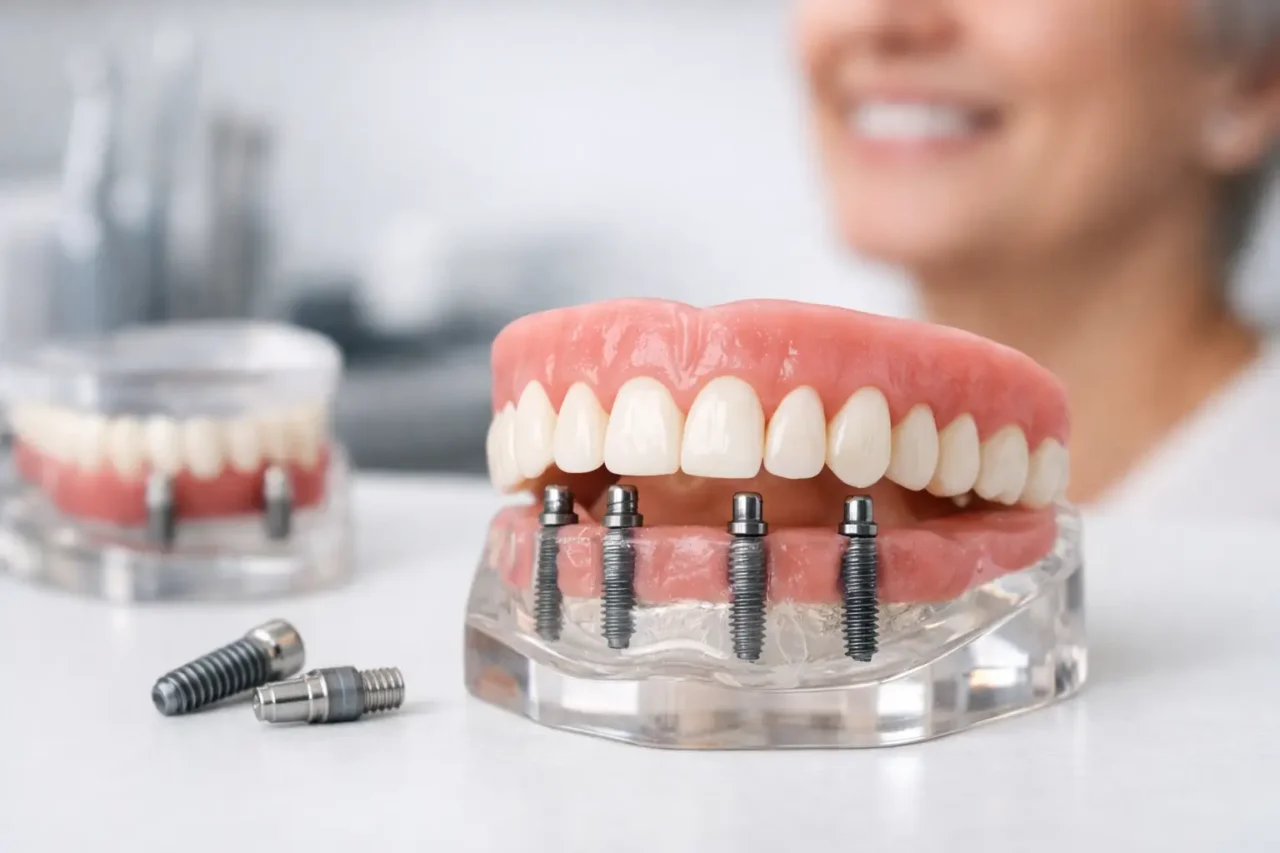
A loose lower denture can turn ordinary moments – ordering dinner, laughing with friends, speaking during a meeting – into something you have to manage carefully. That is where implant supported denture benefits become meaningful: this treatment can give a removable or fixed full-arch prosthesis a secure foundation, helping it feel more stable, comfortable, and natural in daily life.
For patients with many missing teeth or failing teeth, implant-supported dentures are often a practical middle ground between conventional dentures and a full mouth of individual implant crowns. The right option depends on your bone health, medical history, smile goals, budget, and how much treatment time you can allow. A personalized evaluation is the only reliable way to determine whether you are a candidate.
What Is an Implant-Supported Denture?
An implant-supported denture is a custom prosthetic arch that attaches to dental implants placed in the jawbone. Rather than resting only on the gums, the denture is supported by implants that act as artificial tooth roots.
Some designs are removable by the patient. Often called snap-on or overdentures, these click into place over attachments and can be removed for cleaning. Other designs are fixed, meaning they are secured by the dental team and are not removed at home. A fixed full-arch bridge may offer the closest feel to natural teeth, while a removable design can be easier to clean and may require a lower initial investment.
The number of implants varies. A lower denture may be stabilized with as few as two implants in appropriate cases, while fixed arches typically require more support. Your dentist will use imaging, bite analysis, and a review of your available bone to recommend a design that is stable and safe for your specific mouth.
9 Implant Supported Denture Benefits That Matter
1. More confidence when you speak and smile
Traditional dentures can shift when you talk or laugh, particularly as the gums and jawbone change over time. Implant support helps hold the prosthesis in a predictable position. Many patients feel less self-conscious because they are not constantly checking whether their denture has moved.
That emotional benefit is not superficial. Feeling comfortable in photos, business conversations, and social settings can make a real difference in how freely you show up each day.
2. Better chewing stability
A denture that moves under pressure makes chewing difficult. With implants anchoring the prosthesis, patients can usually chew more comfortably and efficiently than they could with a loose conventional denture.
This does not mean every food becomes effortless immediately. Healing, bite adjustment, and adapting to a new prosthesis take time. Still, stable support can make it easier to enjoy a broader range of foods, including many proteins, fruits, and vegetables that may have been difficult before.
3. Less pressure on the gums
Conventional dentures distribute chewing force over the gums. Implant-supported dentures redirect much of that force through the implants into the jawbone. This can reduce sore spots and irritation caused by denture movement.
Fit still matters. Even an implant-retained denture needs careful design, routine adjustments, and healthy soft tissue. If it feels painful, rocks, or causes persistent irritation, it should be evaluated rather than tolerated.
4. A more secure fit throughout the day
Denture adhesive can help some conventional denture wearers, but it is often an ongoing inconvenience. Implant attachments give the restoration mechanical retention, so the denture stays in position without relying on adhesive for basic stability.
For frequent travelers, this can simplify daily routines. You are less likely to pack adhesives or worry about an unexpected shift while dining out, touring Cartagena, or spending a long day in meetings.
5. Support for jawbone preservation
After teeth are lost, the jawbone no longer receives the stimulation created by natural tooth roots. Bone resorption can continue over time, changing facial support and making a conventional denture harder to fit.
Dental implants transmit chewing forces to the bone, which can help preserve bone in the areas around them. They cannot reverse every change that has already occurred, and bone grafting may be needed if significant bone has been lost. But placing implants can be an important part of a long-term plan to protect your oral foundation.
6. A more natural-looking smile
A well-planned implant denture is not only about replacing teeth. The shape, color, tooth proportions, gum design, and lip support all influence the final appearance.
This is especially important for patients who have worn dentures for years or have experienced facial changes after tooth loss. A custom prosthesis can be designed to restore a fuller, balanced smile while still looking appropriate for your features, age, and personality.
7. Clearer speech for many patients
Loose dentures can affect pronunciation because the tongue and lips are trying to adapt around a moving appliance. A more stable prosthesis gives the mouth a consistent surface to work against, which can make speech feel more natural after an adjustment period.
There may be a short learning curve with any new denture. Reading aloud, speaking slowly, and attending follow-up appointments can help the dental team refine the fit and bite.
8. Fewer day-to-day compromises
Patients who have struggled with removable dentures often describe a long list of small accommodations: avoiding certain meals, using adhesive, carrying a backup case, or declining invitations because they are worried about their teeth. Implant support can reduce those compromises.
The goal is not perfection or a promise that maintenance disappears. It is a restoration that works more reliably with your lifestyle, whether that means enjoying a meal with family or feeling prepared for a client presentation.
9. A durable long-term treatment option
With proper planning and consistent care, implants can provide long-lasting support for a full-arch restoration. The prosthetic teeth and attachments may need maintenance or replacement over the years due to normal wear, but the underlying implant foundation can make future care more manageable.
Long-term success depends on daily cleaning, professional hygiene visits, bite protection when appropriate, and avoiding smoking or uncontrolled health conditions that can affect healing. Implant dentistry is an investment in health and function, not a one-time purchase with no follow-up.
Choosing Between Removable and Fixed Options
A removable implant-supported denture may be a strong choice if you want better stability than a conventional denture while keeping home cleaning straightforward. It can also be suitable for patients whose budget or anatomy makes a fixed option less practical.
A fixed full-arch restoration may appeal to patients seeking the highest degree of stability and a closer-to-natural-teeth experience. It generally involves more implants, more detailed planning, and a higher investment. Cleaning requires a disciplined routine with specialized brushes or flossing tools because the prosthesis remains in place.
Neither option is automatically better. The best choice is the one that balances appearance, function, maintenance needs, bone anatomy, treatment timeline, and financial comfort.
What International Patients Should Plan For
Dental tourism works best when treatment is planned around biology, not only flight dates. Implant placement and final restoration are sometimes completed in stages to allow healing and osseointegration, the process in which bone bonds with the implant. Some patients may qualify for an immediate temporary restoration, while others need a more cautious timeline.
Before traveling, share recent dental X-rays or CBCT scans if available, medical history, medication information, and clear photos of your smile. An online consultation can clarify likely options and help you understand whether additional procedures, such as extractions, bone grafting, or treatment for gum disease, may be needed.
At Smile Makeover Cartagena, the treatment journey can be planned in fluent English, with clear recommendations, customized quotes, and appointment coordination before you arrive. The objective is straightforward: excellent clinical care and a natural-looking result, with enough guidance that you can focus on your recovery as well as your time in Cartagena.
Care After Your New Smile
Implant-supported dentures need daily attention. For a removable design, take the denture out as directed, clean the attachments and gums gently, and follow your dentist’s instructions for overnight wear. For a fixed restoration, use the recommended brushes, water flosser, or threaders to clean beneath the bridge.
Regular examinations are essential because implants can develop inflammation if plaque accumulates around them. A professional visit allows your dentist to assess gum health, check the bite, inspect the prosthesis, and replace worn components before small issues become larger repairs.
A stable smile can change how you eat, speak, travel, and connect with people. The next helpful step is not choosing a treatment from a list – it is having an experienced implant dentist evaluate your needs and create a plan built around the life you want to live.

